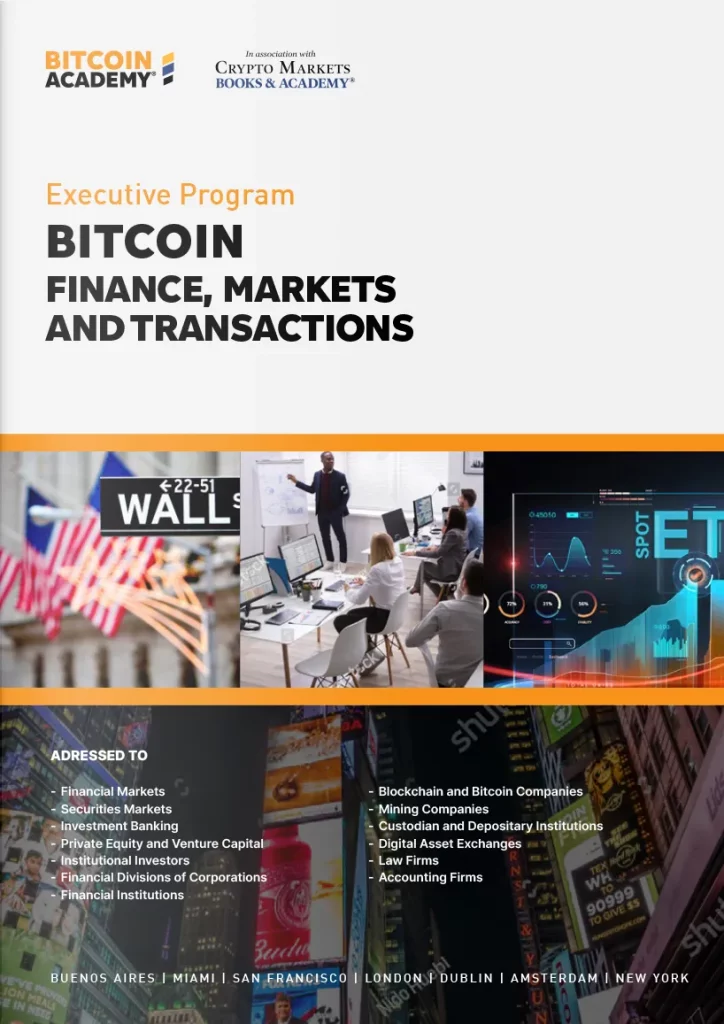
BITCOIN Finance & Markets
Transactions, Deals & Regulatory Framework
Key topics will include:
- Fundamentals of Bitcoin Issuance, Custody and Transfer
- What is Bitcoin: Software, Blockchain, Ledger, Digital Asset, Commodity, Money, Digital Capital and Store of Value
- Fundamentals of Money
- Bitcoin as Private and Commodity Currency
- Bitcoin as a Financial Asset
- Bitcoin as Digital Capital
- Bitcoin Corporate Governance
- Bitcoin Markets
- Bitcoin Transactions
- Exchange Transactions
- Mining Economics
- Mining Financing
- Bitcoin ETF
- Bitcoin Lending
- Bitcoin Smart Contracts
- Bitcoin Layer 2 (LN) Transactions
Program Description & Main Topics to be Discussed
This program aims to provide an in-depth analysis of Bitcoin within the contexts of finance, markets, and regulations. It adopts an interdisciplinary approach that encompasses business, finance, and regulatory frameworks. The curriculum covers a diverse array of subjects, including the processes involved in Bitcoin issuance, custody, and transfer, as well as various conceptualizations of Bitcoin as software, blockchain technology, ledgers, digital assets, commodities, currency, digital capital, and stores of value.
Furthermore, the program will delve into several key areas: the Fundamentals of Money, Bitcoin as a Private and Commodity Currency, Bitcoin as a Financial Asset, Bitcoin as Digital Capital, and Corporate Governance in Bitcoin.The syllabus will also address significant topics such as Bitcoin markets, Bitcoin transactions, exchange transactions, mining economics, mining financing, Bitcoin smart contracts, and Bitcoin layer 2 (Lightning Network) transactions.
Additionally, the program will analyze the emergence of Bitcoin exchange-traded funds (ETFs), their influence on the market, and the regulatory framework as well as equity based on Bitcoin. It will also discuss the expanding domain of Bitcoin lending, analyzing platforms, interest rates, and risk management strategies.
To enhance accessibility and engagement, the program will present content in a clear and relatable manner. This will involve using real-world examples, case studies, and interactive discussions to encourage participant questions and idea sharing. By breaking down complex concepts into manageable segments, the program aims to foster a deeper understanding of Bitcoin and its use in the business world and financial markets.
Executive program for:
- Financial Markets
- Securities Markets
- Investment Banking
- Private Equity and Venture Capital
- Institutional Investors
- Financial and Legal Divisions of Corporations
- Financial Institutions
- Law Firms
- Blockchain and Bitcoin Companies
- Mining Companies
- Custodian and Depositary Institutions
- Digital Asset Exchanges
- Accounting Firms
(*) Definitive Versions of the Agenda will be Available from March 27
(18 credit hours)
AFTER ALL, WHAT IS BITCOIN
- Multiple Concept
- Satoshi Nakamoto White Paper
- Open Source Software Code
- Decentralized Blockchain Network
- Public and Open Decentralized Ledger
- Digital Asset/Sequence of Digital Signatures
NATURE OF BITCOIN BASED ON ITS BUSINESS PURPOSE
- Private Currency
- Payment System
- Commodity
- Investment Product
- Digital Capital
FUNDAMENTALS OF MONEY
- Functions of Money and Economic Definitions
- Regulatory Considerations
- Political Economy Considerations: Money as Mean to Finance the Sovereign
- Fiat Money Regime
- Discussion on the Legal Authority of the Fiat Money Regime
- Private Currencies as Substitutes for Legal Tender
- Academic Proposals for Private Money
- Digital Projects
- Crypto Projects: Bit-gold and E-money
- Economic Foundation of Private Currencies
- Legal Cases on Private Currencies
FUNDAMENTALS OF THE FEDERAL RESERVE SYSTEM
- Foundations
- Federal Reserve System Of Money Creation And Transactions
- Monetary Policy Tools
- Powers Related To Non.Banking Institutions
- Special Monetary Programs
- Programs In 2008-2010
- Programs In 2020-2021
- The Intersection Between Monetary and Policy Aspects
BITCOIN AS PRIVATE CURRENCY
- Purported Purpose and Theoretical Capabilities: Bitcoin as Private Currency
- Bitcoin and the Functions of Money in Practice
- Factors for Supply and Demand and the Increasing Adoption
- Legal Authority
- Bitcoin and the Fiat Sovereign Monopoly
- Bitcoin as the First Real Competing Currency to the Sovereign Monopoly
- Adoption of Bitcoin as Legal Tender in El Salvador
- Bitcoin Laws and Regulations in El Salvador
- The Sovereign Position: the IMF Position on Crypto Assets and Legal Tender in El Salvador
BITCOIN AS RESERVE ASSET
- The Position of the U.S. Government
- Legal Aspects
BITCOIN MARKETS
- Dynamics of Bitcoin Trading Markets
- Market Participants
- Trading Strategies
- Price Formation
BITCOIN AS A FINANCIAL ASSET
- Analyzing Bitcoin’s attributes as a financial asset
- Volatility
- Associated Risks
- Potential for Portfolio Diversification
BITCOIN AS DIGITAL CAPITAL
- Foundation
- Role in Capital Markets
- Influence on Conventional Investment Strategies
PRINCIPAL LAWS & REGULATIONS ON BITCOIN
- Regulatory Fundamentals and Key International Regulations on Bitcoin
- Regulatory Aspects in the United States: The Stance of the SEC, CFTC, FinCEN, and IR
- European MiCA
- International Regulations
BITCOIN FINANCIAL TRANSACTIONS
- Financial Transactions with Bitcoin
- Transactions in Exchanges
- Contractual Terms and Conditions
- Margin Transactions
- Derivatives and Short Selling
- Bitcoin Smart Contracts
- Bitcoin Lending
- Bitcoin DEFI
- Bridges and Layer 2 Platforms
EXCHANGE TRANSACTIONS
- Spot Trading
- Market Makers and Market Takers
- Margin Trading
- Derivatives
- Swaps
- Short-Selling
BITCOIN ETFs
- ETFs Rules and Regulations in the United States
- The Grayscale Case Law and the Position of the SEC
- Prospectus and Terms and Conditions
- International ETFs
BITCOIN LENDING
- Fundamentals
- Transactions
- Loan in Bitcoin Units
- Loan in Fiat Currency Backed by Bitcoin
- Margins
- Liquidations
- Main Terms and Conditions
MINING FINANCING
- Fundamentals
- Financing Structures
- Capital and Debt
- Bond Structures
- Equity
- Guarantees
- Cases
EXPANDING BITCOIN´S PAYMENT FUNCTIONS: UNDERSTANDING THE LIGHTNING NETWORK
- The Rationale for Its Creation and Advancement: Limitations of Bitcoin Payments
- The Basics of the Lightning Network
- Second Layer Network
- Main Characteristics
- LN Nodes and Wallets
- HASHED TIMELOCK CONTRACT (HTLC)
- Transactions
In-company:
On-Site, Hybrid and Virtual
SEMINAR METHODOLOGY – Offered Exclusively In-Company. The ideal group of participants is between 50 and 75 individuals, with larger audiences considered on a case-by-case basis.
Organizations can register personnel residing in different locations and countries, provided that they belong to the same organization or group of organizations.
Executive Program: Smaller groups of 5 to 20 individuals are also a good choice to consider, especially when a more intensive and accelerated learning process is needed. For this purpose, we offer executive professional programs tailored to smaller, more concentrated groups.
Modalities (Seminars and Executive Programs): Intensive In-Person, Hybrid and Entirely Virtual
The program is conducted in-company, featuring three formats: an intensive in-person option, a hybrid model that combines in-person and virtual sessions and a fully virtual option. The program will be dictated in a highly engaging and participatory manner, incorporating numerous activities and exercises to facilitate optimal learning and the effective application of concepts in the workplace upon participants‘ return to their usual positions. The programs is led by a director and a group of guest lecturers from diverse backgrounds, practice specialties and countries. They are responsible for different parts of the curriculum, all contributing to create an engaging learning environment.
On-Site Programs: The program is conducted directly at client locations, allowing for a more collaborative environment. This format enables participants to engage in hands-on activities and discussions that are directly relevant to their specific organizational context. On-site programs also facilitate team-building and networking among participants, enhancing the overall learning experience. This format allows in-person interaction with the program director, while guest speakers may participate either in-person or through video conference, depending on the case.
Hybrid Format: Combining the best of both worlds, hybrid programs integrate in-person and online learning components. Participants may attend some sessions on-site while others are delivered through virtual platforms. This flexible approach allows organizations to maximize participation by accommodating varying schedules and geographical constraints. Hybrid programs also leverage technology to enhance interaction and engagement, ensuring that all participants, regardless of their location, can benefit from the program’s content and resources.
Fully Virtual Format: These programs are conducted entirely online, providing participants with the convenience of accessing high-quality education from anywhere in the world. Utilizing advanced digital tools and platforms, fully virtual programs offer interactive learning experiences, including live webinars, discussion forums, and multimedia resources. This format is particularly advantageous for global organizations with distributed teams, as it eliminates travel costs and time constraints while still delivering impactful educational content.
The program consists of a total of 18 credit hours structured as follows, as may be adjusted by the preferences and needs of the institutions taking them:
- Intensive On-site Format: three half-day and one full-day sessions.
- Hybrid Format: One full-day session or two half-day sessions conducted in person, complemented by (i) three virtual sessions.
- Virtual Format: Between six and ten sessions.
Costs/Administrative Aspects:
Mr. Eugenio Andrea Bruno
Guest Speakers and Visiting Professors
We will invite guest speakers and visiting professors for each jurisdiction based on specific criteria, ensuring that we select individuals with the most relevant expertise and experience to meet the unique needs of each area. This approach allows us to bring in distinguished professionals and scholars who can offer valuable insights, share their knowledge, and enhance the overall learning experience. By carefully assessing the distinct characteristics and requirements of each jurisdiction, we can create a diverse roster of speakers and professors who will elevate our program and facilitate a dynamic exchange of ideas. This focused engagement strategy not only enhances the educational experience for participants but also encourages collaboration and networking opportunities in both academic and professional settings.